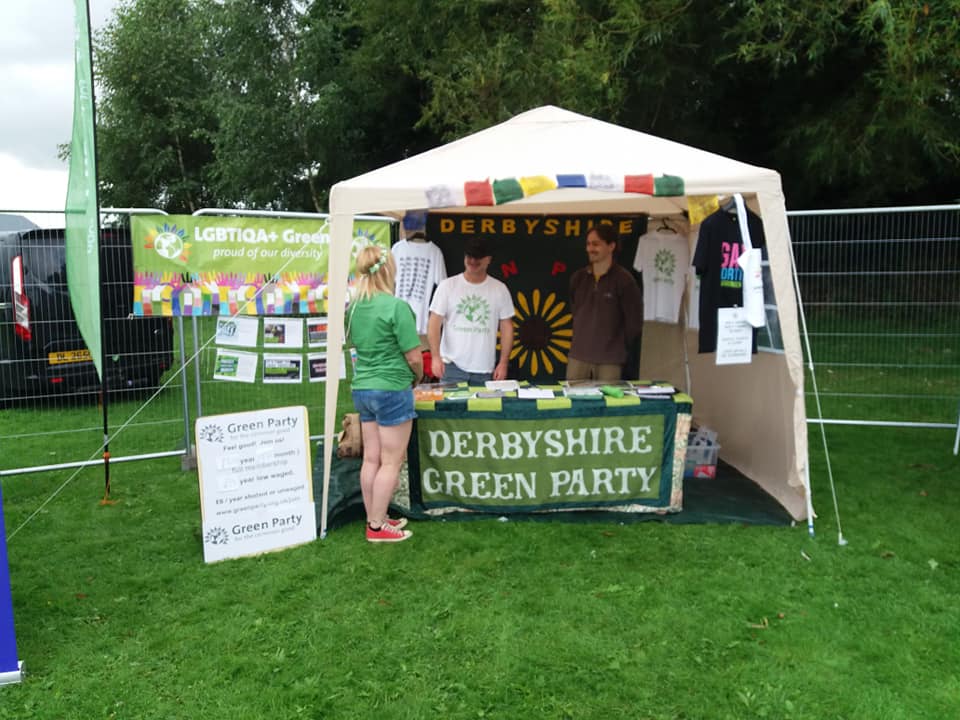
The moral imperative: We need all the energy we can get — it will be a mixture. Anyone who expects the lights to come on at the flick of a switch has a moral duty to accept renewable energy in all but the most exceptional circumstances. There’s a government planning policy statement that says as much (PPS1 CC supplement)
Green Party policy #1: Renewable energy is the most beneficial to the planet and the human race. Wind power is one of the lowest carbon sources; its ultra safe and it’s our own energy resource. The more wind energy, the less need for carbon rich sources and unsafe import-dependent nuclear energy, which isn’t low carbon. Storage is an issue that we’ve been slow to address but there are several technical solutions. The Green Party is urging massive investment in renewable energy. Renewable energy is part of the Green Party’s drive for a million green jobs (go to http://www.greenparty.org.uk/policies.html) selected quote:-
“A massive increase in the proportion of electricity that comes from renewable sources – raising wind energy production to the same level as Denmark by 2020 would alone create 200,000 jobs.”
Green Partypolicy #2: “Fair is worth fighting for” It is essential that no-one in the local community suffers unfairly from these machines. Neighbours should be compensated appropriately within a fair and transparent system. The local community, whose local assets are being used, should benefit from a share in the venture, ideally through an opportunity to own or part own machines or by some other contribution.
Peak District National Park Authority: The Matlock turbines are not in specially protected countryside. I live in and used to work for the Peak National Park Authority. My LPA, the PDNPA, has now twice spent significant resources on objections to wind farms and even on a legal challenge. The basic case against wind farms inside the Park is that on entering and being in the Park, it should visibly be a special place. The converse surely applies. Once inside the Park and looking out, one should expect a difference. I believe it is inappropriate for the PDNPA to oppose wind farms outside the Park on the basis of distant views from a small area in the Park. It should learn from the Carsington decisions.
Local opinion: For the last 5 years I have worked for Sustainable Youlgrave (SY)*. The PDNPA urged SY to assess local support for SY’s proposals for a limited number of individual wind turbines. We agreed; and carried out opinion polls. A significant majority of those polled are in favour of wind turbines in our valley, even where seen from the interviewees’ homes. I’m aware of no such poll before resources were spent opposing the Carsington and Matlock installations.
by John Youatt, electoral agent for Cllr Josh Stockell, the Green Party parliamentary candidate for the Derbyshire Dales. (* SY is strictly apolitical. I resigned my chairmanship of SY on taking up a role for the Green Party)
It is well known that the Green Party cares for the environment. What is less well known is our full range of policies covering social policy, the economy and global issues. High Peak Green Party Candidate Peter Allen and his team will be out on the streets during the next few weeks telling voters about these other Green Party policies.
“We don’t just want to save the planet, we want to make life so much better for people living on it” says Peter.
The Green Party has a fully-costed programme to transform Britain into a self-reliant, fair and sustainable country that contributes to making a fairer world. Among its policy commitments are:
A massive investment programme in public transport, renewable energy and social care, creating a million jobs in a Green New Deal
Expanding and defending the NHS and stopping further privatisation.
More money to fight world poverty, and to help poor countries combat climate change.
Bringing the troops home from Afghanistan and cancelling Trident.
Fairer taxes based on the ability to pay, and a clamp down on tax avoidance. Require banks to reinvest in sustainable projects.
The problems we face are enormous, and climate change threatens our very survival. The business-as-usual policies, offered by the other parties, will fail again. Now is a time of opportunity for us to work together to develop the answers to problems that affect us and our children.
“The obsession with economic growth at any cost must be replaced by sustainable development, and a fair distribution of the world’s resources” says Peter.
Green Party members will be leafleting in Glossop on Saturday morning (6th) in New Mills (13th), Chapel (20th) and Buxton (27th).
The Green Party supports the Robin Hood tax campaign at http://robinhoodtax.org.uk/ and resolves to include a financial transactions tax in its 2010 general election manifesto.
The Green Party re-emphasises its commitment to a fairer society both in the UK and globally.
The Robin Hood Tax differs fundamentally from James Tobin’s original concept as its principal motivation is the raising of revenue as opposed to being a way of regulating speculative financial activity.
James Tobin first proposed his tax in the 1970s as a way of ‘throwing sand in the wheels’ of currency markets rather than harnessing their extraordinary volumes as a means of generating income. More recently the idea of a wider Financial Transactions Tax covering the full range of products traded in the financial markets, has gained ground. Even levied at a very low rate, a yield of $400 billion a year could be realised.
The media as a means of shorthand refer to the Financial Transaction Tax as the Tobin Tax. In fact, Tobin made his proposal specifically about currency transactions. When he made his proposal 30 years ago, the foreign exchange market had a daily value of $18 billion. The market is now worth more than $3,000 billion per day. Tobin’s proposal was for a 1% levy, 200 times the rate the Robin Hood Tax campaign is proposing for the taxing of foreign exchange. The purpose of his tax was to impede daily currency trading and to discourage speculative activity, not as we propose to be a means of raising new revenue to fight poverty, at home and abroad.
The Robin Hood Tax differs markedly from the Tobin tax in that it is born of a different time, proposed at a different rate and designed for a different purpose.
There is a proliferation of new waste disposal technologies, these need to be carefully evaluated in terms of their carbon footprint. Some are good, some less so. The Greens are not against new technology. While domestic waste is coming under control and is now decreasing in England and Wales (around 27 million tonnes annually) commercial and industrial waste continues to grow, though it has been kept in check by the recession. Industry is not yet covered by direct targets on waste. These will come in via European legislation which the Green Party supports. This should help industry wake up to the fact that waste is an avoidable cost, and also represents a loss of potential profit.
The Green Party calls for waste minimisation as a priority, then reuse, recycling and recovery of value (including) energy, and finally landfill. In principle, we would support the concept of zero waste, in practice the policy recognises that it will take time and investment to achieve this. Green Party policy opposes incineration. The reason is that it represents a waste of resource and thwarts our long-term aim of zero waste. However, the issue of pollution as a result of incineration can be overstated. All modern incinerators now operate under the Waste Incineration Directive. They are the cleanest of combustion plants, cleaner than roads! The main problem with incinerators from our point of view is that they conform to the centralist economic/political model rather than the decentralist strategy that we propose. They tend to be large, ‘industrial-scale’ plants which require inputs (including waste) to travel large distances to make them viable.
Green Party policy is cautious on gasification, the technology rejected in Derby. It looks like the technology proposed would incorporate plastic in the gasification process, in which case the energy output, be it gas or electricity, would not be renewable. This is one of our reasons for opposing it. In addition, it looks like it is a big facility bringing waste in from all over Derbyshire, adding up the transport carbon footprint, again reason for opposition. It is unlikely that emissions would be a serious issue, gasification occurs necessarily in a closed low oxygen environment, so emissions are minimised. The question about the ‘bottom ash’ remains.
Anaerobic Digestion (AD) is generally welcomed, though it has limitations that policy-makers need to understand. It causes only a partial breakdown of the biomass content of waste, a significant residue remains for disposal. This can be used for compost if it is clean, that requires full screening of the input waste, which involves expense. The residue has to have a long-term market. Land has a limited capacity for taking applied compost: over-apply it and methane will be produced. The markets also need to be nearby so that transport miles are not being stacked up. Therefore, AD is good on a small scale in rural areas and with a segregated waste stream, e.g. food and garden waste, doubtful for big urban areas, and still need waste segregation and a solution to residual waste.
The Green Party calls for more recycling and curbside segregation, however some curbside schemes seem to be getting out of control. Stockport now has a 3 or 4 bin system. We should consider the carbon footprint of all these bins, which are made from petrochemicals, and be sure that no further collection miles are being created compared to a single bin collection. In some residential areas such as flats, segregated bin systems do not work, so to meet targets, some form of waste processing is necessary. In cities it might be better to go back to single bins with weekly collections and invest in clean, state of the art materials recycling facilities with energy-generation to power the process and the collection fleet. Such a closed cycle system is technically possible now.
The Green Party focused on housing for the start of their campaign in the High Peak. Candidate Peter Allen was joined by Party activists on the streets of New Mills and Glossop, handing out leaflets to highlight housing policy. Peter Allen said,
“The Green Party believes that everyone has the right to an affordable and secure home. We must set out to do this without doing further damage to our environment.”
“The Greens say that where new housing has to be built, it must be to a high standard of energy efficiency. The Greens also point out that better use could be made of the existing housing stock. Local authorities do not exercise the powers that they already have to make owners bring empty properties into use, and in the meantime properties are left empty whilst many people cannot secure an affordable home. It is wrong that wealthy second home owners leave holiday property empty while local people are denied a home.”
Commenting on the response of the people he met, Peter Allen said,
“people were telling me that they had been intending to spoil their ballot papers or stay at home, feeling cut off from politics and disgusted by the expenses scandal. They thanked us for offering an alternative and said they would seriously consider supporting the Green Party, with it’s commitment to environmental sustainability and social justice.”
The Greens will be campaigning in Buxton next Saturday.
The Green Party knows that there is a housing crisis across Britain. We believe that access to affordable secure housing is a human right. In the High Peak nearly 4000 households are on the housing waiting list, yet less than 500 council and housing association homes were let in 2008/9. To address this shortfall the government requires around 5,000 additional homes to be built in the High Peak by 2026. We accept that some new building is necessary but we would plan new housing on the basis of independent housing needs surveys. Builders’ representatives have far too much influence over planning policy at present. Green policy requires that new homes are built to high energy efficiency standards and sited to minimise their impact on the environment. Existing homes should benefit from a nationwide insulation programme, reducing carbon emissions and creating Green Jobs. An immediate priority is to make better use of existing homes and buildings. Local authorities must use their powers to bring empty properties into use. It is wrong that wealthy second homeowners leave holiday property empty while local people are denied a home.
Peter Allen is your Green Party candidate in the High Peak. He continues:
The Green Party offers the voice of hope in Britain today. Our vision is for a fair and sustainable society. We have policies that tackle the economic and environmental crisis. After the election of Barack Obama in the US, for a moment the world dared to hope. That hope is now fading. The unwinnable war in Afghanistan has got worse. Despite the economic crisis that they caused, greedy bankers are still paying themselves massive and totally unjustified bonuses. Nothing was achieved at the Copenhagen Climate Conference. Nevertheless the hope and expectation that brought Obama to power remains. To quote Naomi Klein, “What the election and the global embrace of Obama’s brand proved decisively is that there is a tremendous appetite for progressive change; that many, many people do not want markets opened at gunpoint, are repelled by torture, believe passionately in civil liberties, want corporations out of politics, see global warming as the fight of our time, and to be part of a political project larger than themselves.”
We need to build a movement for radical change. Will you help us by getting involved (email: getinvolved@derbyshiregreenparty.org.uk) or by making a donation? Cheques, payable to Derbyshire Green Party can be sent to Slatelands House, Slatelands Rd, Glossop, Sk13 6LH
The Green Party position on Afghanistan is quite clear: we are against the power of the military-industrial complex, and we always doubt that violence and wars are a useful tool of policy, when all considerations are taken into account. We were against the invasion of Afghanistan, and if it were up to us, we would withdraw our troops immediately and unconditionally. However, given the real-politik of the present position, we can only advise Government on the best way to extricate themselves from the position in which they have foolishly placed our troops.
We accept that the government is not going to perform an immediate and unconditional withdrawal. Their plan, insofar as such may exist, is to train up the Afghan army, and to build up the competence of the Afghan government institutions until they can take over the security of the country. The latest wheeze is to try to bribe moderate Taliban to stop fighting.
Our opponents will argue that immediate withdrawal will lead to the collapse of the Afghan state, effectively handing it back to the Taliban, with all that means in terms of religious freedom, human rights, the position of women, flying kites, stoning, amputations &c. There is also the point that the lives of all those British soldiers would have been sacrificed in vain.
Our counter to this is that, given the present situation, the best way to achieve success, both in terms of getting our troops out with honour and to stabilise the Afghan state with some semblance of democracy, is to buy the opium and use it to relieve the agony of 6,000,000 people who die in Africa each year with untreated terminal pain. Most here will have experienced a friend or relative die of cancer in the UK, aided by morphine. Just imagine what that process would be like without any painkillers.
The advantage of the Opium Purchase policy is:
1. Win hearts and minds of the farmers
2. Pull the financial rug out from under the Taliban
3. Greatly reduce the damage done to our society by illicit morphine
4. Relieve the suffering of terminal cancer in Africa
5. Reduce corruption in Afghanistan
6. Enable our troops to come home with honour.
This policy is endorsed not just by the Green Party of England & Wales, The European Greens, the Afghan Red Crescent, the Italian Red Cross, the European Parliament, the International Council on Security and Development, but most recently a serving US army officer, which shows that it is gaining ground.
The central objection to this argument, presented by the Foreign Office to Caroline Lucas in correspondence, is that the mechanisms to buy and process the opium are not in place. This begs the question of why we do not use a fraction of the money being spent on the military effort to put them in place? That is what government is for, and it is what a Green Party government would do.
The Green Party will stand three candidates in Derbyshire in the forthcoming General Election.
Peter Allen, 49, of Glossop will represent the Green Party in the High Peak constituency. Peter says:
I am delighted that voters in High Peak will now have the chance to vote Green. This election will be the most important in recent times: Britain and the world face a perfect storm as we suffer the worst financial crisis in living memory, while millions of people are losing their homes due to climate change, and the search for continued growth wreaks devastation on the world’s rainforests and ecology. To cap it all, we experience an energy crisis, as easy-to-mine fossil fuels diminish. Only the Green Party offers the right response, with our programme for sustainable living and social justice.
To underline the urgency of Climate Change, Peter will be travelling to London with other Green Party members to take part in The Wave demonstration next weekend. Expected to attract a million participants, this event will demand that the world’s leaders face up to the dangers of global warming now and begin to implement policies necessary to ensure the survival of humanity on the planet. Green Party leader Caroline Lucas recently spelled out our collective challenge:
We now have to recognise that climate change is potentially the greatest challenge we’ve ever faced. At the same time the measures we need to tackle it, like a massive investment in energy efficiency and renewable energy will actually make jobs, and will help us out of recession.
The other two Green Party candidates in Derbyshire are:
In case anyone believes David Cameron’s greenwash, we suggest they take a look at the attached letter by Patrick McLoughlin MP, objecting to the proposed Carsington wind farm.
The intention of Derby City Council to cut approximately 465 jobs is indicative of the recent feeding frenzy and panic by all 3 main parties to drastically cut everything — which we condemn.
When unemployment has already reached 2.5 million, now is not the time for such action, which is bound to affect many frontline services.
Scrapping Trident, ID cards, and expensive PFI contracts would be a better approach.
Voters wishing to cast a positive vote now have one clear choice — the Green Party.
Recent Comments